
Gold is one of the few things that holds value in a way people can actually measure. That is why, when money is tight or a drawer needs clearing, the question becomes very specific, very fast: how much pawn shops pay for gold.
Here is the straight answer without the dance. Most pawn shops base gold offers on a percentage of the item’s melt value when the piece is treated as scrap. That percentage varies by shop, by market conditions, and by what the item is. A clean, desirable piece of jewelry may be valued above melt because it can be resold as jewelry. A broken chain may be treated as scrap and valued closer to melt minus a margin for testing, processing, and resale risk.
This guide shows you how the math works, what changes the offer, and what to do if you want the best legitimate outcome. You will also see how selling gold differs from pawning it, what “cash for gold” alternatives get wrong, and how to compare offers without feeling pressured.
See how we buy gold, silver, and platinum in Chicago
The quick answer most people want
When people ask about a pawn shop gold price, they are usually trying to figure out one thing: “If I bring my gold in today, will the offer feel fair?”
A fair gold offer starts with melt value. From there, the final number depends on the shop’s process, the shop’s confidence in what you brought in, and whether your piece has value beyond scrap.
Two truths can exist at once.
- You can estimate melt value at home with basic inputs.
- You cannot know the exact offer without inspection, because small details change outcomes.
If you are comparing options, start by learning melt value. Then focus on the factors that move an offer higher, not just the headline percentage.
Melt value explained in one minute
“Melt value” is not a pawn shop term. It is a metals term. It means the raw gold content value inside the item, calculated from three inputs.
- Weight
- Purity (karat)
- Spot price (the market price of gold)
If you strip away design, branding, and stones, melt value is the baseline number most scrap offers start from.
Spot price is not the same as an offer
Spot price is a global market reference. It moves daily and can move throughout the day. A shop offer is a buy price with real world considerations. The shop needs to test the metal, verify purity, handle processing, and resell the gold in a way that makes business sense.
That difference is not a “trick.” It is the gap between a quoted market price and an actual transaction.
Why your piece may be worth more than melt
If a piece is desirable as jewelry, it can be priced with resale in mind. A well made necklace in a popular style can sell as jewelry, not as scrap. In that case, a shop may value it above melt because the buyer is not buying “gold,” they are buying a finished item.
How pawn shops work and how offers are determined
Calculate melt value and understand the range
If you want to sanity check offers, you need a way to estimate melt value. This is not about turning you into a gold buyer. It is about giving you a grounded reference point.
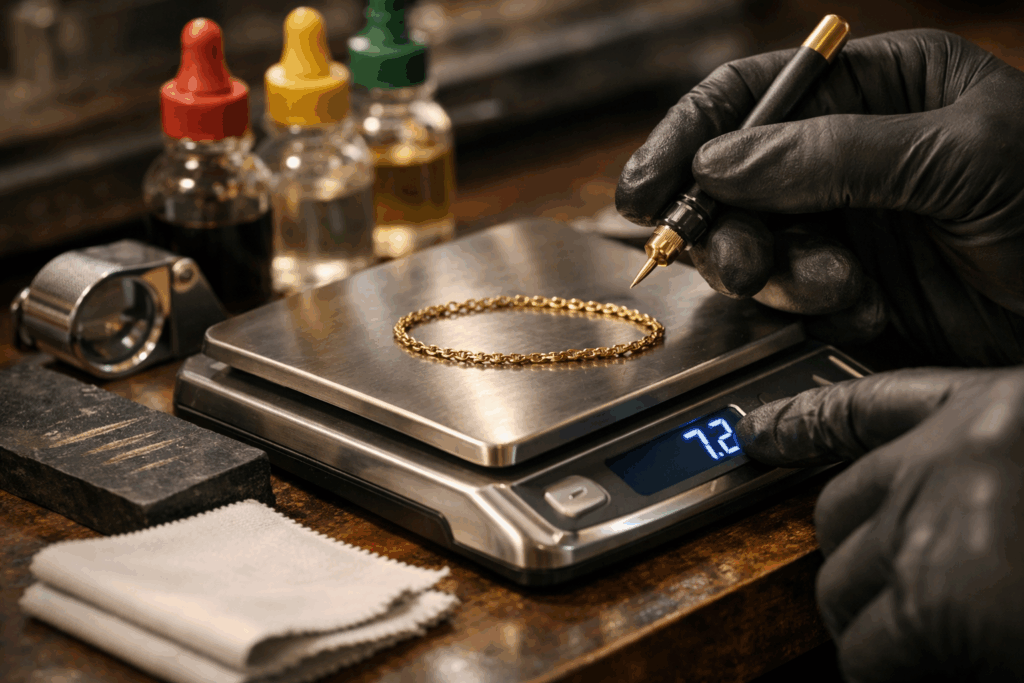
Step 1: weigh your gold in grams
Grams are the simplest unit for quick estimation. If you only have ounces or pennyweight, convert to grams so you are not guessing.
Step 2: identify karat purity
Common purity levels and their approximate gold content:
- 10k: about 41.7% gold
- 14k: about 58.5% gold
- 18k: about 75% gold
- 22k: about 91.6% gold
- 24k: about 99.9% gold
Stamps help, but stamps are not proof. Plated items can be stamped. Old pieces can be worn. A reputable shop tests.
Step 3: use today’s spot price
Gold prices move. If you are calculating melt value, use the same day price. If the price moved sharply, the “fair” offer moved too.
The simple formula
Melt value estimate = weight in grams × purity percentage × spot price per gram
That gives you a baseline number.
From there, offers vary based on the piece.
- Scrap gold offers often start as a percentage of melt.
- Jewelry resale offers can be higher than melt.
If you want an estimate quickly, use a calculator that does the math cleanly.
Try our pawn value calculator and gold estimator
The factors that change how much pawn shops pay for gold
People fixate on percentages because it feels like the whole story. In reality, the biggest differences usually come from what the item is and what the shop believes it can do with it.
Purity: 10k vs 14k vs 18k is not a small difference
Higher karat gold contains more gold per gram. That is why 18k often produces a noticeably higher melt value than 10k at the same weight.
But purity also changes how jewelry wears. Some lower karat pieces hold up differently because of alloy content. The point is not to “prefer” one. The point is to know what you have.
Weight and construction: hollow jewelry changes the math
Two chains can look similar and weigh very differently. Hollow links, thin walls, and lightweight construction lower melt value.
This is why weighing matters. A photo cannot tell you what a scale can.
Scrap gold vs jewelry resale value
This is the factor most sellers underestimate.
- A broken chain with missing clasp is often treated as scrap.
- A clean bracelet in a desirable style may be treated as a finished product.
Shops that actually sell jewelry can sometimes value desirable pieces differently than a buyer who only ships scrap.
Stones and mixed materials
Stones can increase value, but they can also complicate evaluation.
A piece with stones might be worth more as jewelry, or it might be worth about the same as scrap if the stones are small, heavily included, damaged, or not marketable.
Mixed metal pieces can also reduce certainty. When testing is harder, offers can become more conservative.
Market movement and timing
If gold is up, your baseline is up. If gold is down, the baseline is down. Simple. But the important part is psychological: people remember last month’s headlines and assume the price is the same today.
If you want to compare offers, compare offers made on the same day.
Testing and risk: why reputable shops explain what they do
A serious buyer tests and weighs transparently. That is how trust is earned.
If a seller is uneasy, the best questions are simple.
- What is the weight
- What karat did you test it at
- What price are you using today
If a shop cannot explain, that is information.
What a pawn shop gold price can look like in real situations
Instead of promising a single number, it is more honest to describe the scenarios.
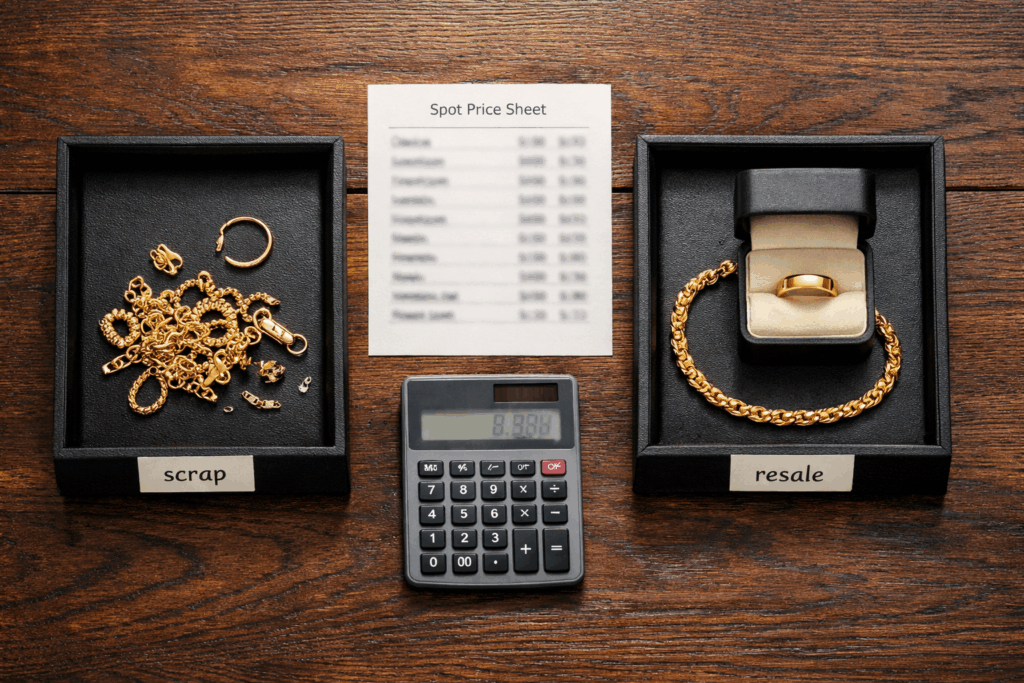
Scenario 1: broken gold jewelry treated as scrap
A broken chain, single earring, missing clasp, or damaged piece is often valued as scrap. The offer is usually tied closely to melt value because the item is not likely to be sold as jewelry.
Scenario 2: wearable jewelry with resale value
A clean, wearable piece with strong resale appeal may be valued above melt because it can be sold as jewelry. The shop’s offer reflects what it believes it can resell it for, not just what it can melt it for.
Certain branded pieces or well made jewelry can behave differently because buyers pay for design, not just metal. In those cases, an evaluation should look beyond melt.
This is why two gold items with the same weight and karat can receive different offers.
Selling gold vs pawning gold
If you are selling gold, you are trading the item for cash and walking away.
If you are pawning gold, you are using the item as collateral for a loan. You keep the option to redeem the item later.
The best choice depends on your goal.
- If you want maximum simplicity and you do not want the item back, selling is clean.
- If the item has sentimental value and you want the option to reclaim it, a pawn loan can be the better fit.
Asking for both options in store is reasonable. Seeing the numbers side by side often makes the decision obvious.
Pawn shop vs mail in cash for gold
Mail in services are built for volume. Local transactions are built for clarity.
The biggest differences tend to be:
- Transparency: in person evaluation lets you watch the process and ask questions.
- Speed: you can get a number the same day.
- Control: you do not ship an item and wait for someone else to grade it.
This does not mean every mail in service is wrong. It means the process is different.
If you want to compare offers, do it on equal footing. Use the same day spot price, confirm weight and purity, and compare the offer against melt.
For many people looking for cash for gold Chicago, the benefit of a local shop is simple: you get your questions answered face to face.
How to get top dollar for your gold
If you want the best legitimate outcome, focus on removing uncertainty. Uncertainty is what pushes offers down.
Bring the right things
- A government ID
- Any paperwork, receipts, or appraisals you have
- Matching pairs and sets
- Boxes for branded jewelry if you have them
Present items clearly
You do not need to polish gold. You do need to make inspection easy.
- Untangle chains
- Separate pieces by karat stamp if possible
- Avoid harsh cleaning methods
Check the price the same day
Because gold moves, comparing today’s offer to last month’s headline is a bad comparison.
Ask to see the weight and testing
A reputable shop will weigh and test your gold and explain what it found. You do not need a chemistry lesson. You need the basics.
- What does it weigh
- What karat is it
- What price are you using today
Get a quote, then decide
A good evaluation should not feel like a trap. If you feel rushed, step back.
Get the best price for your gold in Chicago
If you want a real offer based on what your gold actually is, the fastest move is an in person evaluation. We test and weigh your items, explain what we see, and give you a number you can accept or decline.
Get the best price for your gold in Chicago. Visit Clark Pawners for a free evaluation. We base offers on real time gold prices and the specific qualities of your piece, not guesswork.
No obligation. No pressure. You walk out with clarity, and you decide what happens next.
Visit Clark Pawners for a free evaluation
Frequently asked questions
Do pawn shops pay spot price for gold
Typically, no. Spot price is a market reference, not a buy offer. Most offers are based on melt value with adjustments for testing, processing, and resale risk. In some cases, jewelry may be valued above melt if it has resale appeal.
What percentage of melt value is a normal offer
There is no universal percentage. Offers vary by market conditions, item type, and shop process. Scrap offers often use melt value as the baseline, while desirable jewelry can be priced differently.
How do I calculate melt value at home
Weigh the gold in grams, identify the karat purity, and multiply weight × purity percentage × spot price per gram. That gives a baseline melt estimate, not a guaranteed offer.
Is 10k gold worth selling
It can be. 10k contains less gold than higher karat jewelry, so melt value is lower, but it still has real gold content. The best way to know is to weigh it and test it.
Do pawn shops pay more for jewelry than scrap
Sometimes. If a piece can be resold as jewelry, the shop may value it above melt. If it is broken or not marketable as jewelry, it is more likely to be treated as scrap.
Is it better to sell gold or pawn it
Selling is best if you want cash and do not want the item back. Pawning can be better if you want cash now but want the option to redeem your gold later. Ask for both options and compare.
Should I remove stones before selling gold jewelry
No. Removing stones at home can damage the setting or cause loss. Bring the piece in and let a professional evaluate it safely.
Do broken chains get less money
Broken chains are often treated as scrap because they are harder to resell as jewelry. The offer is usually tied closely to melt value.
Can I get a gold estimate without leaving my gold
In many cases, yes. A shop can evaluate and quote in store and you decide what to do next. The key is in person testing and weighing.
What should I bring to get the fastest quote
Bring a government ID and any paperwork you have. Bring matching pieces and accessories when relevant. Untangle chains and separate items if you can. The goal is fast inspection with minimal uncertainty.
Final takeaway
Gold is not mysterious when you look at the right inputs. Weight, purity, and spot price give you a baseline. The offer you receive depends on how confidently a buyer can test the piece and whether it has resale value beyond melt.
If you want the best outcome, do not chase slogans. Get a clear evaluation, ask the simple questions, compare offers made on the same day, and choose the option that fits your goal.
And if you want a fair, transparent quote in Chicago, bring your gold to Clark Pawners. We will evaluate it, explain it, and let you decide with the facts in front of you.

