
If you’re reading this, you’re not looking for theory. You’re trying to turn something you already own into money fast, without getting talked in circles, oversold, or surprised at the counter. This guide is built for that moment.
You’ll get a practical framework for what can i pawn, how to size up a pawn estimate before you leave the house, and what actually sits behind the question how much does pawn shop pay. Then we’ll walk through ten categories that tend to perform well in Chicago, each with a realistic payout range and one tip that can meaningfully change the offer.
Quick cash pawn: what “quick” really means (and what it doesn’t)
A quick cash pawn situation is about speed and simplicity: you bring an item, it’s evaluated, and you leave with cash the same day if you accept the offer. “Quick” doesn’t mean every item is automatically worth real money, and it doesn’t mean the first number you hear is the only number that exists.
What “quick” usually does mean in practice:
- You’re not listing anything, shipping anything, meeting strangers, or waiting on a buyer.
- The shop has to be able to verify the item, assess demand, and price risk in minutes—not days.
- The item needs to be straightforward to resell (or straightforward to collateralize for a loan).
What “quick” does not mean:
- It doesn’t mean every category has the same payout logic.
- It doesn’t mean you’ll get “retail” value.
- It doesn’t mean the offer won’t change if something is missing (charger, box, paperwork) or if the condition isn’t as expected.
If you treat this like a short, professional transaction, bring the right items, bring the right basics, you’ll get a faster process and a cleaner offer.
What can i pawn: a practical way to spot “pawnable” value at home
Before you grab a bag and head out, it helps to know what typically reads as value from a shop’s perspective. The goal isn’t to turn your house into an inventory project. The goal is to identify pawn shop items that can be priced quickly and responsibly.
1) The three traits of strong pawn shop items
Most strong pawn shop items share three traits:
- Clear resale demand
Items with steady local demand are easier to price and easier to move. That lowers the shop’s risk—often improving your offer. - Verifiable authenticity
If the shop can verify what it is (brand, metal, model, stone, condition) without guessing, you’re in a better position. - Condition that doesn’t require rehab
A shop isn’t looking for a “project.” They’re looking for something that is ready to resell or dependable enough to collateralize.
2) What to skip (and why)
Some items waste your time because they’re hard to resell, hard to verify, or expensive to refurbish. That doesn’t mean they have zero value—just that they often don’t create a strong pawn estimate.
Common examples include:
- Items that need repair to function
- Extremely outdated electronics
- Off-brand luxury lookalikes with no proof
- Items missing key parts that make them usable (batteries, power supplies, proprietary pieces)
If you’re unsure, the sorting method below keeps you from overthinking it.
3) A quick “keep / bring / don’t bother” sorting method
Use this three-bin approach:
- Bring: you can verify what it is (brand/model/metal), it’s in decent condition, and it still has market demand.
- Keep (for now): you think it’s valuable, but you’re missing important info (paperwork, charger, accessories) and want to find it first.
- Don’t bother (today): it’s broken, incomplete, or so old that pricing will likely disappoint.
This method doesn’t require expertise. It simply lines up your items with how a shop makes decisions in real time.
Pawn estimate: how to get a realistic number before you walk in
You don’t need an appraisal to get a pawn estimate, but you do need a few basic details. The goal is not to “win” the transaction. The goal is to show up prepared so the offer reflects the real item, not an assumption.
The info that changes the estimate fast
These details move the number more than most people expect:
- Exact model or reference (especially for watches, phones, laptops, tools)
- Storage size / configuration (electronics)
- Metal type and purity marks (gold jewelry)
- Stone details and any documentation (diamonds)
- Condition facts (cracks, missing links, non-working buttons, battery health)
Small differences (a higher storage tier, a newer generation, an intact bracelet) can change an offer meaningfully. The clearer you are, the tighter the pawn estimate becomes.
What to bring to tighten the estimate
Bring only what helps verify identity and completeness:
- A government-issued ID
- Original charger or power supply when applicable
- Boxes/papers for luxury items when you have them
- Any certificates you already possess for diamonds or handbags
No paperwork? You can still get evaluated. But if you have documentation, bringing it is an easy advantage.
How much does pawn shop pay: how offers are actually calculated
People ask how much does pawn shop pay as if there’s a single universal answer. There isn’t. But there is a consistent logic behind most offers, and once you understand it, the numbers make more sense.
Loan value vs resale value
A shop is balancing risk and liquidity. That’s true whether you’re taking a loan or selling outright.
- A loan offer is anchored to what the shop can safely lend while protecting itself if the item isn’t redeemed.
- A purchase offer is anchored to what the shop can pay and still resell responsibly after overhead, testing, and market risk.
Either way, the “retail price” you see online is not the number a shop uses. The shop’s number is based on realistic resale and risk.
What percentage do pawn shops pay (what that question is really asking)
When someone asks “what percentage,” they’re usually trying to reverse-engineer fairness.
The more useful way to think about it: your offer is influenced by (1) resale certainty, (2) verification clarity, (3) condition and completeness, and (4) local demand. If those are strong, the offer tends to be stronger. If those are weak, the offer drops because the shop is absorbing more risk.
Why Chicago demand can change the offer
Chicago is a large, active resale market. That can help certain categories: popular electronics, high-demand tools, mainstream luxury, and collectibles with a local buyer base.
At the same time, a large market can be picky. Items that are common or heavily worn may face more competition. In practice, demand and competition move the offer in opposite directions depending on category, another reason preparation matters.
Pawn shop loans: what you’re agreeing to, in plain English
Pawn shop loans are designed for a simple use case: cash today, the option to reclaim your item later. The key is to treat the loan terms as the product, not just the cash.
Loan term and redemption basics
A pawn loan typically includes:
- A loan amount based on the item
- A defined time window
- Fees/interest as laid out in the agreement
- A redemption process (pay back the loan + fees to get the item back)
If you’re considering a loan, ask for the terms clearly, then decide based on your real timeline—not wishful thinking.
The clean decision point: “Do I want this back?”
This question prevents most regret.
If you want the option to get it back, pawn shop loans are often the better fit. If you know you do not want it back, selling may be cleaner.
You can also ask for both options (loan and purchase) and choose on the spot, more on that later.
Top 10 items to pawn for quick cash (with Chicago payout ranges + one tip each)
The ranges below are meant to set expectations—not lock in a number. Your final offer will depend on brand, condition, completeness, and verification.
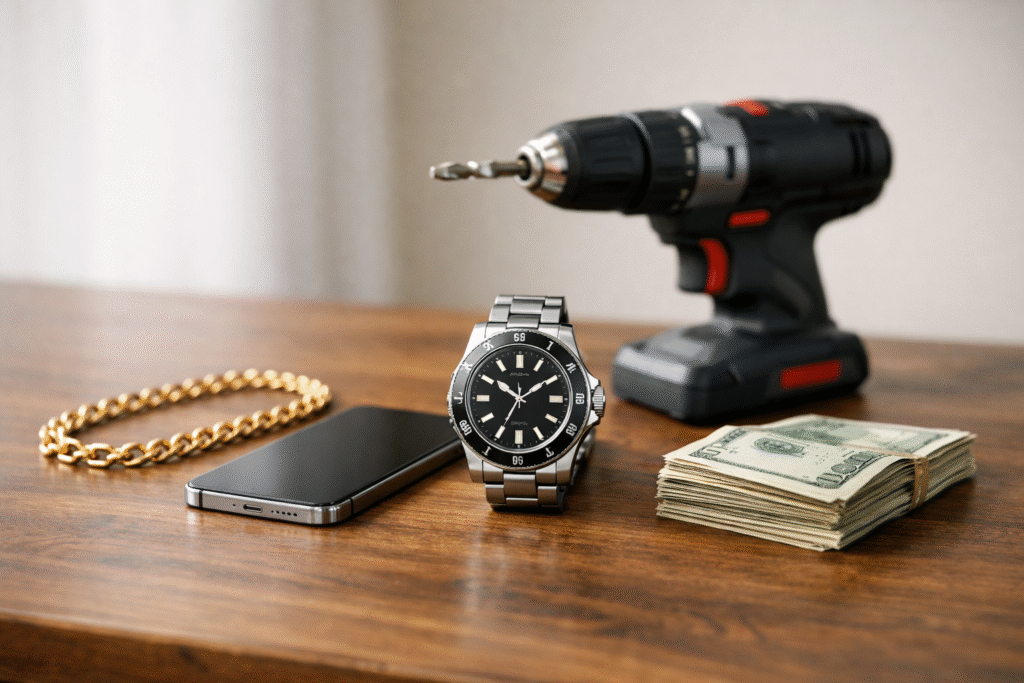
Gold jewelry
Why it performs well: Gold has intrinsic value and a transparent market anchor, which makes it easier to price quickly.
Typical range in Chicago: Many everyday pieces land anywhere from $50 to $1,500+, depending on weight and purity. Heavier or higher-purity pieces can exceed that.
One tip: Don’t guess purity—look for hallmarks (like 10k/14k/18k) and bring matched sets together. If you have multiple small items, grouping them can help create a cleaner evaluation.
“How Much Do Pawn Shops Pay for Gold?” (gold education / value expectations)
Diamonds
Why it performs well: Diamonds can be high value in a small footprint, but only when quality and authenticity are clear.
Typical range in Chicago: A modest diamond ring might fall around $100 to $1,500, while higher-quality stones and better settings can go higher—sometimes significantly.
One tip: If you have paperwork (certificate, prior appraisal), bring it. It can reduce verification friction and support a stronger offer. If you don’t, don’t panic—just avoid DIY “tests” that can damage the setting.
“How to Test if a Diamond Is Real” (education + expectations)
Luxury watches
Why it performs well: Certain brands have steady buyer demand and predictable resale behavior.
Typical range in Chicago: Depending on brand and model, offers can range from $150 to $5,000+. Mainstream luxury with box/papers trends higher than “watch-shaped status items.”
One tip: Bring the box, papers, extra links, and any service record you have. Completeness can materially change the outcome.
Electronics (phones and laptops)
Why it performs well: Popular models are easy to resell when they’re functional and clean.
Typical range in Chicago: Phones often land around $40 to $400, laptops around $75 to $700, depending on age, specs, and condition.
One tip: Bring the charger and fully reset the device (sign out, remove locks) before you come in. Locked or un-reset devices slow evaluation and can weaken the offer.
Power tools
Why it performs well: Working tools, especially pro-grade, have steady demand.
Typical range in Chicago: Individual tools often fall around $30 to $250, while kits and higher-end setups can go higher.
One tip: Bring batteries, charger, and case if you have them. Tool-only offers are often lower because the buyer wants a complete working setup.
High-end handbags
Why it performs well: Demand exists for authentic luxury, but the shop must be confident it’s real.
Typical range in Chicago: Depending on brand and condition, offers often sit around $100 to $2,000+.
One tip: Authenticity proof matters. Bring any receipts, dust bag, cards, or packaging you have. Also, avoid trying to “fix” wear yourself, DIY cleaning can backfire.
Musical instruments
Why it performs well: Instruments can hold value when they’re reputable brands and playable without repair.
Typical range in Chicago: Many instruments fall around $75 to $600, while pro-grade or desirable models can go higher.
One tip: Bring the case and any key accessories. A missing case or hard-to-verify model can slow the process and soften the offer.
Gaming consoles
Why it performs well: Popular consoles have predictable resale, especially when complete and tested.
Typical range in Chicago: Often $75 to $300 depending on generation, storage, and completeness.
One tip: Bring all cords and at least one controller. Missing essentials turns a quick transaction into a troubleshooting conversation.
Rare collectibles (coins and currency)
Why it performs well: True collectibles can carry value beyond face value, but grading and authenticity matter.
Typical range in Chicago: Many common items are modest ($20 to $200), while rarer pieces can exceed $500+ depending on scarcity and condition.
One tip: Don’t clean coins. Cleaning can damage surfaces and reduce value. Bring them as-is so the condition can be evaluated properly.
Selling to a pawn shop: when selling makes more sense than a loan
Selling isn’t “worse” than a loan. It’s just a different tool.
The “I don’t want it back” checkpoint
If you know you do not want the item back, selling is often the cleanest decision. It removes future obligations and eliminates the need to track redemption timelines.
Highest possible payout vs fastest payout
Some selling paths outside a shop can potentially yield more in certain cases, but they often require time, uncertainty, and effort. Selling in person is usually about speed, certainty, and privacy.
If your priority is to get cash today without running a multi-week process, selling in person can be a practical choice.
How to compare both options in one visit
A smart approach is to ask for two numbers:
- What the loan would look like (if you choose pawn shop loans)
- What the purchase offer would be (if you choose selling)
Then decide based on your actual intent. This is especially useful when you’re unsure or emotionally torn.
Chicago context: what to expect when you walk in
This section is about reducing friction. A faster visit usually comes down to preparedness, not luck.
What you’ll typically need to bring
- A government-issued ID
- The item (clean, complete, functional if relevant)
- Essentials that prove completeness (charger, cords, controllers, batteries)
- Documentation only if you already have it (don’t delay the visit to “get paperwork” unless it’s easy)
How the in-shop process usually works
In a straightforward transaction, you can expect:
- A quick evaluation
- Clear explanation of the offer
- The chance to accept or decline without pressure
- Cash paid if you accept
If you’re deciding between a loan and a sale, ask for both options. That keeps the conversation practical.
How to get in and out quickly
- Bring complete items (chargers, cords, batteries)
- Reset electronics ahead of time
- Don’t bring broken items expecting miracles
- Be clear about whether you prefer a loan or a sale—or ask for both
If you’re looking for cash loans chicago, the “quick” part is rarely the paperwork. It’s almost always the item readiness.
Quick reference wrap-up: what to bring first
If you’re prioritizing speed and a clean pawn estimate, start with the categories that are easiest to verify and most consistently in demand.
Highest-confidence items
- Gold jewelry
- Luxury watches (especially with box/papers)
- Popular phones and laptops (reset + charger)
- Complete gaming consoles
“Worth bringing if ready” items
- Diamonds (especially with paperwork)
- Pro-grade power tools (with batteries/charger)
- High-end handbags (with authenticity support)
- Musical instruments (playable + case)
“Don’t waste a trip” items
- Broken electronics
- Incomplete devices missing essential parts
- Items you can’t identify at all (no brand/model, no markings, no proof)
- Anything you suspect is counterfeit
FAQ
1) What can I pawn for $100?
A $100 target is realistic in many cases, but it depends on what you bring and whether it’s complete and verifiable. Everyday gold jewelry, a decent-condition phone, a complete gaming console, or a quality power tool can reach that level in many shops. If you want to maximize your chances, focus on pawn shop items that are functional, complete, and easy to verify. A quick pawn estimate in-store is often the fastest way to confirm.
2) What do pawn shops pay most for?
Categories with high value density and strong resale demand tend to perform well: gold jewelry, diamonds (when quality is clear), and luxury watches are common examples. Electronics can also do well when they’re newer models in good condition. If your question is really how much does pawn shop pay, the deeper answer is: shops pay most confidently when the item’s identity and market demand are clear.
3) Can I get cash the same day?
Yes, same-day cash is the normal outcome for a quick cash pawn visit when the item is straightforward to evaluate and you have ID. The most common causes of delay are missing parts, questionable authenticity, or electronics that aren’t reset/unlocked. If you’re considering pawn shop loans, you can typically complete the process the same day as well.
4) What slows down the process?
The biggest slowdowns are preventable: missing chargers or accessories, locked electronics, incomplete kits, and items that require deep verification. Counterfeit concerns also slow things down—especially with handbags and sneakers. If you’re trying to move fast, bring items that are complete and easy to verify, and ask for a clear pawn estimate up front.
Contact Us Today
If you have one of these items and need cash, bring it to Clark Pawners. Chances are we accept it and can walk you through your options—whether you want a straightforward sale or you’re considering pawn shop loans. Even if your item isn’t on this list, ask us; we evaluate a wide range of valuables and can give you a clear, on-the-spot pawn estimate.Check out What We Buy!

